

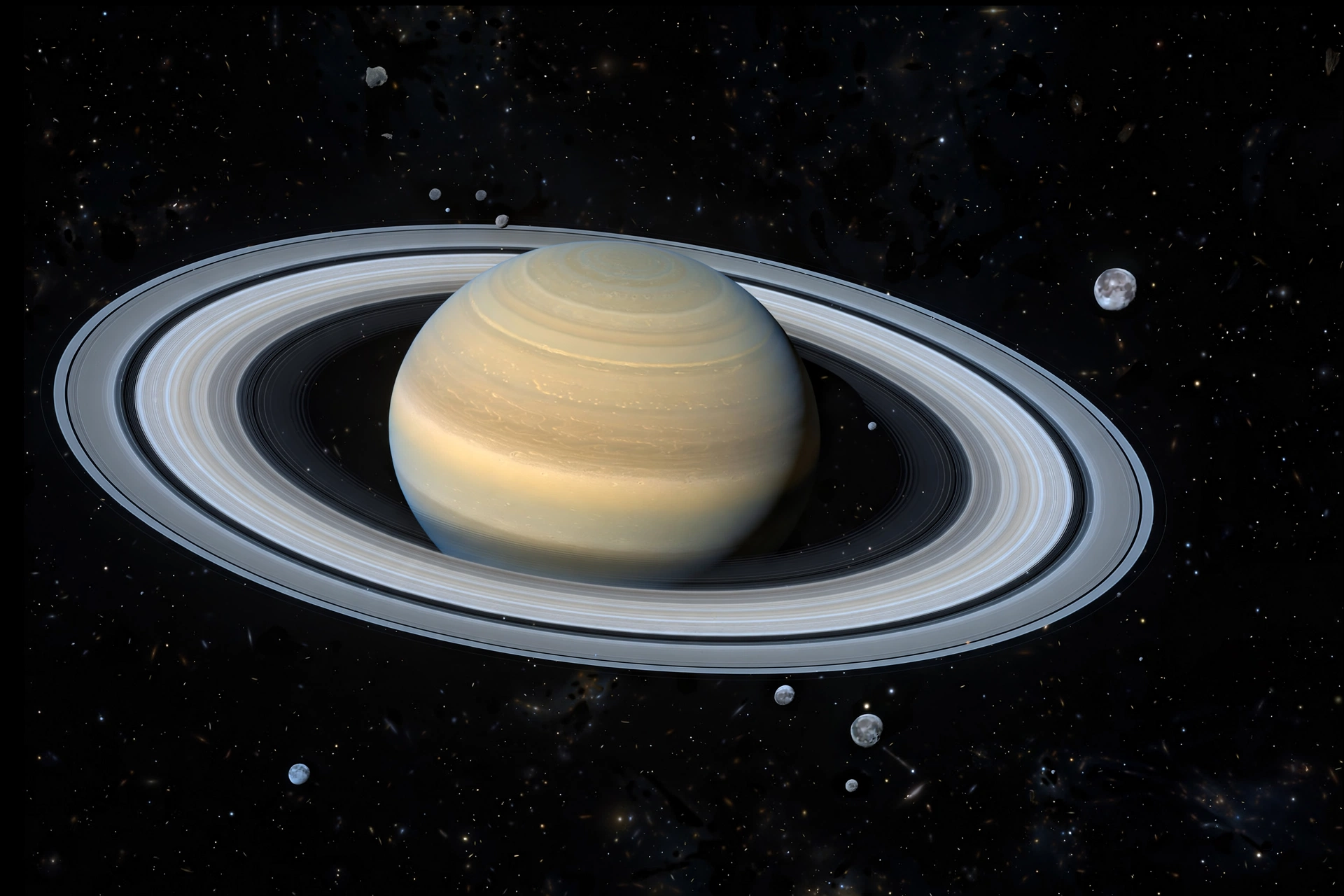
Saturn is now, by a wide margin, the planet with the most known moons. Astronomers have confirmed 128 new moons, bringing the official total to 274 and ending any near-term contest with Jupiter or the other giant planets. The figure is larger than the moon counts of all the other planets combined. For a national audience used to space news arriving as launches and landings, this story is quieter but just as significant: it changes the basic reference facts taught about our own solar system.
Where the discovery came from
The survey behind the announcement used the Canada-France-Hawaii Telescope on Mauna Kea, one of the world’s major observing sites. Over several years the team collected deep images of the space around Saturn and searched them for objects moving at the planet’s pace. Researchers from the University of British Columbia took a leading role, including Dr Edward Ashton, and the new moons were recognised by the International Astronomical Union, which maintains the formal record. Details of the observatory’s work are available from the Canada-France-Hawaii Telescope.
The method, called shift and stack, is central to understanding why the announcement arrived as a large group. Individual exposures were shifted to follow Saturn’s expected motion and then stacked, allowing extremely faint objects to emerge from the combined data. Each candidate still needed an orbit, however. Astronomers had to show that it returned where prediction said it should, night after night and year after year, before it could be counted.
Small moons, strange paths
Anyone picturing 128 copies of our own Moon should adjust the image. The new arrivals are tiny, typically a few kilometres across, dark and irregular. They keep their distance from Saturn and follow tilted orbits, many of them retrograde, travelling opposite to the direction of the planet’s rotation. Their appearance and paths suggest they are fragments, pieces of larger moons that were captured by Saturn long ago and later smashed apart in collisions.
That history makes the moons scientifically valuable out of proportion to their size. A fragment family preserves evidence of an impact that no spacecraft witnessed. By comparing the orbits within a family, scientists can work backwards toward the original body and the collision that dispersed it, adding detail to the story of how the outer solar system settled into its present form.
Why Americans are hearing about it now
Reference totals change only when the evidence is strong enough for the international community to accept it, which is why a discovery gathered over years can surface as a single headline. Our newsroom has covered the more theatrical side of recent space activity, including a launch visible across the East Coast, but this announcement is about the archive as much as the sky. It rewards observatories that keep high-quality data and teams prepared to mine it patiently. Similar context on keeping complex systems current appears in our technology coverage of keeping app versions up to date, a reminder that maintenance, in space science as in software, is where much of the value sits.
A record that may keep growing
Is 274 the final number? Almost certainly not. The same surveys that produced this group are sensitive only down to a certain size and brightness, and fainter fragments are expected to exist. Future telescopes and better processing may push the count higher still, here and around other planets. For the moment, though, Saturn’s lead is emphatic. A planet famous for its rings now holds another distinction that is unlikely to be challenged soon: it is orbited by a swarm of at least 274 recognised moons, most of them small, distant and only recently brought into the official record.
How teachers and textbooks catch up
Changes like this reach classrooms slowly. Textbooks, planetarium shows and reference websites all have to be updated, and many will round the story down to a single line: Saturn, 274 moons. Behind that line sits a useful lesson for students about how scientific facts are made. The number did not change because Saturn gained new material this year. It changed because observers collected enough evidence for objects that were already there. That distinction, between the world changing and our knowledge of it changing, is one of the clearest examples astronomy offers of research working exactly as it should.
